

We love to keep up with the photos and videos of your fabulous cycling tour!
Follow us on Instagram at @bikespaintours and on Facebook at BikeSpainTours, and tag us in the posts from your trip.
Don’t forget to join our Strava club, so we can give you kudos for all your amazing bike rides!
Your guide for this tour will be Raúl: (+34) 667 60 97 75
Gratuities for our guides are much appreciated to thank them for exceptional service, support, and expertise. The industry standard for each individual guest is 7.5-10% tip of the trip price at the end of the tour. Local currency is preferred.
Call the Bike Spain Tours office on +34 915 590 653, or out of office hours call +34 677 356 586. We will get you where you need to be and get you the help you need
Your insurance policy number is SPBESA400000339. You can find your insurance documents here.
In order to prove your status as a pilgrim (and be awarded your Compostela pilgrim certificate once you arrive in Santiago), you will need to obtain a credencial (pilgrim passport) at the start of your journey. Your guides will assist you in this.
Once you have your credencial, make sure that you get it stamped at least twice per day as you travel to Santiago. You can receive stamps in hotels, restaurants, churches, bars, cafés and many other places that you might visit along the way; we recommend that you try to get as many stamps as possible to turn your credencial into a unique souvenir of your trip!
In order to ensure that there is enough space for everyone to travel comfortably in the van, we ask that you bring only one standard hold luggage size suitcase and one rucksack per person.
Click here for our packing suggestions for a guided bike tour.
Click here for our recommendations for cycling safely and legally in Spain.
Please be aware that Spaniards follow a very particular routine in terms of their daily meals, and this is often strictly enforced by restaurant opening hours, especially in small towns!
You can expect restaurants to be open for lunch from approximately 1:30pm – 4pm. Many places will offer a menú del día: a set menu with 2/3 options for each course, usually including a drink, bread and dessert or coffee. Remember that lunch is the main meal of the day in Spain.
Dinnertime in Spain is any time from 8pm onwards. Dinner in Spain is typically a lighter meal.
Walking the Camino de Santiago is not just a pilgrimage for the soul but also a feast for the senses. Here’s a must-try list of regional food and drinks along the way:
León
León is a fantastic place to try traditional Castilian meat dishes such as cecina (cured smoked beef) or morcilla de León (spiced blood sausage with rice). Vegetarians can enjoy sopa de ajo (garlic soup with paprika, bread, and egg). Wash everything down with some prieto picudo wine: a bold red from León’s vineyards.
Astorga and El Bierzo
For breakfast in Astorga, we recommend accompanying your coffee with local mantecadas and hojaldres (soft, buttery sponge cakes and flaky pastries). For a hearty dinner, the local specailty is cocido maragato: a three-course stew with chickpeas, meats, and broth, which is traditionally eaten backwards compared to the rest of Spain: meat first, soup last).
As you head west into El Bierzo wine region, we highly recommend trying the local mencía wine: a fruity, deep red. Specialty dishes here include botillo del Bierzo (slow-cooked pork sausage with potatoes and cabbage), pimientos del Bierzo (roasted sweet red peppers) and castañas del Bierzo (roasted chestnuts).
Galicia
As you cross the mountains into Galicia, you’ll notice that seafood features much more heavily in the local gastronomy! The star dish here is pulpo a la Gallega, or pulpo a feira (octopus sprinkled with paprika, sea salt, and olive oil). Melide is particularly famous for its octopus, although you’ll find it in almost all the towns you pass through in this region. Another very traditional dish is empanada Gallega (a savoury pastry filled with tuna, meat, or seafood). Wash it all down with a glass of crisp albariño white wine!
Santiago de Compostela
Santiago de Compostela is a culinary gem! We highly recommend a tapas crawl to sample as much of the local cuisine as possible. The seafood is of course a highlight, although traditional Galician pork dishes such as raxó and zorza are also very popular. Round off your culinary adventure with a slice of tarta de Santiago: an almond cake dusted with icing sugar in the shape of the cross of St James. Those interested in Galicia’s Celtic heritage might consider booking a queimada: a flaming Galician punch made from orujo (pomace brandy), sugar, lemon peel, and coffee beans, brewed by a meiga (witch)!
Monday, 6th July: León
Accommodation: Parador de León
Hotel services: Restaurant, bar, laundry
Meals included: Lunch
9am: Your guide will pick you up from Avenida de la Osa Mayor, 171B for your transfer to León. In case of any issues, call Raúl on (+34) 667 60 97 75.
Together we’ll travel by van through the Sierra de Guadarrama and over the fertile plains of Castile. We’ll stop for a wine tasting at a local bodega in Rueda, famous for its exquisite verdejo.
Next, we’ll travel by van the short distance to Toro, known for the local variety of red wine: “Tinta de Toro”, which has its own Denomination of Origin status. Due to its strategic location, Toro has been of great importance over the centuries: a stronghold for the Moors and then the Christians in medieval times, as evidenced by its 10th century fortifications, and in later centuries a royal court. The town is built in the shape of a fan, and offers views of the surrounding fertile plains, known as the Oasis of Castile.
1:00pm: Lunch and guided tour at Bodega Fariña.
From Toro, we’ll continue on in our private van to León.
Founded in 68 BC, the ancient city of León will take your breath away. Together, we’ll wander the narrow streets of the city’s old quarter and discover the spectacular Gothic cathedral, which boasts the most beautiful stained glass windows in all of Spain, and admire the Museo Casa Botines de Gaudí, a magnificent example of 20th-century Modernist architecture.
Once we’ve checked into our hotel, we’ll head to the Madres Carbajales convent to get that all-important piece of documentation that will record our pilgrimage – the credencial del peregrino.
For dinner, we recommend a tapas crawl around the Barrio Húmedo, or “wet district”, so called because it’s where you’ll find the highest concentration of bars and pubs!
Click here for our Google Maps list of recommendations in León.
Top of your list should be León Cathedral (open Mon – Sat 9:30am – 1:30pm/4pm – 7pm, Sun 9:30am – 11:30am and 1pm – 3pm), a UNESCO World Heritage Site with a spectacular rose window. Constructed between the mid 18th and early 19th centuries, the Cathedral’s architectural style demonstrates the transition from Late Baroque to Neo-Classical.
León’s colourful Plaza Mayor is well worth a visit: grab a coffee at one of the many cafés and admire the elegant architecture. If your visit coincides with a Wednesday or Saturday, you can visit the traditional market held in the plaza from 9am – 3pm, and sample some local produce.
Basílica de San Isidoro: Consecrated in 1063, this beautiful church (open daily from 10am), houses a Royal Pantheon, covered in stunning colorful frescoes, a museum, a collegiate library and a beautiful hotel and restaurant (open daily 1:30pm – 3:30pm/8:30pm – 10:30pm), where you can dine among the ancient cloisters.
Museo Casa Botines de Gaudí: Famous Catalan architect Antoni Gaudí didn’t just design buildings in Barcelona; among his creations in Castile-León is this magnificent example of 20th-century Modernist architecture, originally a commercial warehouse and private residence (open Thu – Mon 10am – 7pm, Wed 3pm – 7pm).
Discover more about the history of the local area at León Museum, the biggest in Castile-León, and whose collection dates back to the Bronze Age (open Tue – Sat 10am – 2pm/4pm – 7pm and Sun 10am – 2pm).
Art fans will love MUSAC, the Museum of Contemporary Art of Castile-León, which houses works by local and international artists and is famous for its stained glass gallery, designed to mimic the colours of the Cathedral’s rose window.
No visit to León is complete without a tapas crawl around the Barrio Húmedo, or “wet district”, so called because it’s where you’ll find the highest concentration of bars and pubs! From the Cathedral, cross Calle Ancha, an ancient Roman road, and start exploring. You will receive a tapa with each drink order, so we suggest that you order cortos (small beers!)
Some of our favourite tapas bars are: La Bicha (for morcilla, or blood sausage), El Rebote (for croquetas), Jamón Jamón (charcuterie), Rúa 11 (150 varieties of vermouth), El Rincón del Gaucho (garlic soup).
Tuesday, 7th July: Leon – Astorga
Route: 55km/34.6 mi
Elevation: +484m/+1,588 ft
Accommodation: Hotel Via de la Plata
Hotel services: Spa, laundry
Meals included: Breakfast
This first stage traverses classic Castilian landscapes, complete with holm oaks, golden wheat fields and moderate rolling hills. The straightforward route follows the path of the N120 highway. The scenery along the first half of the route is relatively dry, but gets greener the further west you go as the cornfields give way to endless vineyards. Keep your eyes peeled for geckos, birds of prey and dairy cows!
As you ride westward from León, you’ll notice a gradual shift from urban landscapes to rural scenery. The roads are smooth, with occasional gentle inclines.
At Villanueva del Carrizo, you enter the fertile lands of the Órbigo Valley, cycling through vast fields of corn and wheat. The roads here are quieter, making for a peaceful, enjoyable ride, with occasional glimpses of the Órbigo River meandering through the countryside.
We’ll pass through the charming town of Hóspital de Órbigo, named after the pilgrim hospital founded by the Knights Hospitaller in the 16th century next to the Órbigo river. One of the town’s most famous attractions is the Paso Honroso, a medieval bridge where legendary knight Don Suero de Quiñones once held a month-long jousting tournament in which he swore to break 300 lances in honour of unrequited love.
Continuing on from Hóspital de Órbigo, the road follows gentle undulations, offering beautiful views of the valley. As you approach Santibáñez de Valdeiglesias, the route begins to gain elevation, leading into rolling hills with stunning panoramas.
Just before reaching Astorga, we recommend a quick photo stop at the Crucero de Santo Toribio, a stone cross atop a hill from where you can enjoy fabulous views of the Montes de León and Astorga.
Today’s route finishes in the historic town of Astorga. Located at the convergence of the Camino de Santiago and the Vía de la Plata, Astorga offers a rich cultural legacy stretching from Roman times through to 20th century Modernism.
Click here for our Google Maps list of recommendations in Astorga.
Astorga’s Late Gothic Cathedral (open daily 10am – 6pm, closed Sun 11:30am – 1pm for Mass) was built over three centuries, with the result that the stones that make up its walls are from different quarries and are different colours. Don’t miss the figure of St James on the cathedral’s ornate Baroque façade, facing the pilgrims’ route and blessing all those who pass.
Astorga’s majestic Episcopal Palace, or the Palacio de Gaudí, is one of the municipality’s most fascinating buildings, and now houses a museum dedicated to the Camino de Santiago.
The Plaza Mayor is the perfect example of Astorga’s mixture of old and new. Built over the remnants of the Roman forum, the square is home to the 17th century town hall, considered to be one of the finest examples of Baroque architecture in the region. On Tuesday mornings, the Plaza hosts a market (open 9am – 1:30pm) where you can pick up some fresh regional produce.
For a sweet treat, visit Astorga’s Chocolate Museum, (open Tue – Sat 10:30am – 2pm/4:30pm – 7pm and Sun 10:30am – 2pm) which traces the history of the Astorgan families who became official chocolate suppliers to the Spanish Royal Family, and is set in one of their elegant former mansions.
Discover Astorga’s Classical history at the Roman Museum (open Tue – Sat 10am – 2pm/4pm – 6pm and Sun 10am – 2pm), which is housed in an ancient domed building that was once part of the Roman forum.
A very traditional dish in Astorga is cocido maragato, a meat stew that is served one stage at a time: first the meat, then the vegetables, then finally the broth. What makes cocido maragato so special is that the rest of Spain serves their cocido in the reverse order, starting with the broth!
Cocido maragato is the perfect way to replenish calories after a long day of cycling, and we recommend you try it at Restaurante Casa Maragata, which is dedicated exclusively to this dish! They have two establishments in the city: Restaurante Casa Maragata I (open Wed – Sun 10:30am – 5pm) and Restaurante Casa Maragata II (open Fri – Tues from 10:30am – 5pm).
Wednesday, 8th July: Astorga – Canedo
Route: 79.1 km/49.1 miles
Elevation: +1174 m/+3851 ft
Accommodation: Hotel Palacio de Canedo
Hotel services: Restaurante, bar, laundry, garden
Meals included: Breakfast
From Astorga, the Camino climbs gently up to the foothills of your first mountain pass. Once you’ve reached the top of Foncebadón, relax and enjoy the sweeping downhill ride to Villafranca, with gorgeous views of vineyards stretching out endlessly on both sides.
Your first point of interest is the picturesque town of Castrillo de los Polvazares, considered to be one of the region’s most beautiful examples of popular architecture. Take a quick breather to explore the cobblestone streets and admire brightly painted door and windowframes.
The road climbs gently through the picturesque countryside to Rabanal del Camino, a historic pilgrim town at the foot of the Montes de León where you can still find the remains of centuries-old pilgrim hospitals.
Next, you’ll cycle up to beautiful mountain village of Foncebadón, which was largely abandoned until the mid-20th century, when the resurgence of the Camino started to attract new residents.
Just outside of Foncebadón, you’ll come across the famous Cruz del Ferro, the highest point of today’s ride and also the highest point of the Camino Francés, where pilgrims traditionally leave a small stone as a symbol of leaving behind their burdens before arriving in Santiago.
A little later, you’ll pass through the abandoned mountain village of Manjarín before beginning a spectacular descent towards El Acebo de San Miguel. This descent is fast and technical, with sharp bends and stunning mountain views, requiring careful control and attention.
The descent continues through lush green forests, until you cross the medieval bridge into Molinaseca. After Molinaseca, we’ll reach the historic city of Ponferrada, the end of today’s route. Historically a stronghold of the Knights Templar, Ponferrada is still dominated by their imposing 12th century castle.
From Ponferrada, we’ll travel by van to our hotel in Villafranca del Bierzo, at the heart of the El Bierzo wine region.
5pm: Guided tour and tasting at Bodega Prada a Tope.
Click here for our Google Maps list of recommendations in Villafranca del Bierzo.
The town of Villafranca del Bierzo is was originally founded to provide pilgrims with refuge and sanctuary before beginning the most difficult part of their pilgrimage. The town boasts a long and storied history, and is replete with churches and monuments, testament to its importance as a stop on the ancient Camino de Santiago route.
At the entrance to the town, you’ll find the 12th-century Church of Santiago, where pilgrims unable to continue to Santiago de Compostela were able to pass through the Puerta del Perdón (Door of Forgiveness) and obtain forgiveness for their sins.
Continuing into town, you’ll find the Castle-Palace of the Marqueses de Villafranca, which nowadays houses a winery. You can admire more historic palaces by taking a stroll down Calle del Agua, a street replete with the manor houses of the aristocracy of yesteryear.
Your hotel, has its own excellent restauarant serving locally-produced fare; however, if you would like to explore the town further, we recommend the Microhostal Restaurante La Puerta del Perdón (open Tue – Sun 1pm – 4pm), the restaurant at the pilgrim hostel Albergue Viña Femita, or Mesón Don Nacho (open Wed – Mon 8am -4pm/8pm-12am)
Thursday, 9th July: O’Cebreiro – Monforte de Lemos
Route: 66.2 km/41.1 miles
Elevation: +580 m/+1902 ft
Accommodation: Parador Monforte de Lemos
Hotel services: Restaurant, bar, swimming pool, gym, laundry
Meals included: Breakfast and lunch
From Villafranca the Camino climbs up to the mountain village of O’Cebreiro, the most demanding ascent of the western Camino Francés. Fortunately, we can cover this segment in our van!
The tiny mountain village of O’Cebreiro is our first stop in Galicia! The village holds huge cultural significance for the Camino de Santiago, and is well worth taking the time to explore. We highly recommend that you visit the pallozas: oval-shaped stone huts with straw roofs where for centuries local people cohabited with their livestock. The 9th century church of Santa María do Cebreiro is one of the oldest and best-preserved along the whole Camino, and is said to house the Holy Grail! Its bells once rang through the mists to guide pilgrims to safety, and the views when the skies are clear are astounding.
From O’Cebreiro, you’ll cycle through a mix of rolling terrain and short climbs before reaching Fonfría. This section of the ride is characterized by stunning green landscapes, stone farmhouses, and tranquil rural roads.
As you leave Triacastela, the Camino offers us two routes to Sarria. We’ll be taking the route via Samos, allowing usu to visit the magnificent Monastery of Samos, which dates back to the 6th century. This quiet stretch, following the Oribio River, is particularly picturesque, with lush woodlands and peaceful countryside roads.
A gentle climb leads to Oural, a small local hub surrounded by rolling countryside. From here, the road continues south through a peaceful agricultural landscape, with long views across the hills of Lugo province.
Approaching Bóveda, the terrain becomes more open, with broad valleys and scattered stone farmhouses characteristic of the region.
The route then descends gradually toward Monforte de Lemos, the historic capital of Ribeira Sacra. As the city comes into view, cyclists are rewarded with panoramic vistas of the surrounding valleys and vineyards.
3pm: Lunch at Restaurante Vertigo*.
5:15pm: Guided tour and tasting in Bodega Regina Viarum.
Friday, 10th July: Melide – Santiago de Compostela
Route: 51 km/33.8 miles OR 75.5 km/46.9 miles
Elevation: +899 m/+2951 ft OR +1179 m/+3863 ft
Accommodation: Parador de Santiago de Compostela
Hotel services: Restaurant, bar, laundry
Meals included: Breakfast
Today’s stage takes you along forest paths, through the beautiful Galician countryside to your final destination: the Pórtico de la Gloria (“The Façade of Glory”) of Santiago Cathedral!
Leaving Arzúa, the route follows quiet rural roads, weaving through rolling green fields and dense woodlands. The road surface is well-maintained asphalt, making for a smooth ride with only occasional gravel patches on the Camino paths.
The first few kilometers take you through the several tiny hamlets, where traditional hórreos and stone farmhouses dot the landscape. This section is a mix of gentle climbs and flowing descents, offering fantastic morning views over misty Galician hills.
The official end-point of the Camino in Santiago de Compostela is the Cathedral, located in Plaza del Obradoiro. We’ll take a break in the plaza to celebrate our achievement and soak up the amazing atmosphere. There is something indescribably human about the sight of hundreds of daily pilgrims arriving into the plaza, just as countless others have done over the centuries.
Inside the Cathedral, pilgrims traditionally embrace the statue of St James and visit his tomb. Our next stop is the Pilgrims’ Office, where we can obtain our Compostela pilgrim certificates.
Congratulations on the completion of your pilgrimage to Santiago de Compostela!
Click here for our Google Maps list of recommendations in Santiago de Compostela.
Santiago de Compostela was, without a doubt, the most important city in Christian medieval Spain. It’s world-renowned for its cultural and religious significance, and each year thousands of travellers come to visit.
Santiago Cathedral: The end of your pilgrimage and top of your tourist list is Santiago’s magnificent cathedral, which dates back to the 11th century and is one of the few catedrals in the world built over the tomb of an apostle. We highly recommend the cathedral rooftop tour (available daily from 10am – 8pm, reservation recommended). You’ll climb up the cathedral tower and out onto the roof for a once-in-a-lifetime angel’s eye view of Santiago, as well as a unique perspective of the stunning cathedral.
Take a stroll in Alameda Park for fabulous views of the cathedral and the rest of Santiago’s UNESCO World Heritage Site old town. Don’t forget to take a picture with the statue of As Marías, two elderly sisters who used to go for a walk in the park every day at 2pm, dressed in their finery, regardless of civil war, dictatorship or inclement weather!
For more insight into the history of the Camino, don’t miss the Pilgrimage Museum (open Tue – Fri 9:30am – 8:30pm, Sat 11am – 7:30pm and Sundays 10:15am – 2:45pm)
Also well worth a visit is the Museum of the Galician People (open Tue – Sat 11am – 6pm and Sun 11am – 2pm), which explores the unique culture and history of this little corner of Spain. The museum is housed in a former Dominican convent, set in beautiful grounds that are now a public park.
Mercado La Galiciana: This gastromarket is just a couple of years old, and it’s the perfect place to enjoy both local and foreign food. There is an amazing range of eateries, and the place itself is beautifully designed (open Sun – Thu 12pm – 12am and Fri/Sat 12pm – 1am)
For a more traditional experience, visit Mercado de Abastos (open Mon – Sat, 11:30am – 5pm). This historic market is extremely popular with locals, and contains a range of restaurants, traditional market stalls, and even a fishmonger that will cook your purchases for you while you wait!
Santiago de Compostela also has a fantastic tapas culture. You will receive one free tapa per drink purchased, so we recommend that you stick with small glasses of albariño wine! Some of our favourites are Bar La Tita (enormous portions of tortilla) Petiscos do Cordeal (seafood), Benboa (seafood), Viñoteca Ventosela (cheese and charcuterie), Raices Gallegas (traditional Galician dishes including zorza and raxo) and Orella (pig’s ear).
For a sit-down meal, we highly recommend O Sendeiro (open daily until 6pm, and Wed – Sun 8pm – 12am) or A Curtidoria (open Wed – Sat 1pm – 5pm/8:30pm – 12am, Tue and Sun 1pm – 5pm).
Saturday, 11th July
Departure day
Meals included: Breakfast
10am: After breakfast, we’ll depart Santiago in our private van.
2pm: Lunch at Bodega el Capricho (not included).
After lunch, we’ll transfer to Madrid in our private van.
We hope you had a wonderful time exploring the Camino de Santiago with us!
Parador de León GL San Marcos
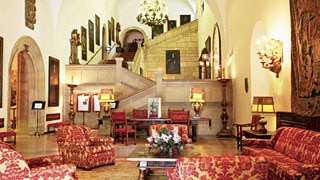
Located in Leon’s historical center, directly in the heart of one of the most impressive Roman complexes of the Peninsula.
The convent of San Marcos is one of the greatest architectural gems of the Spanish town of Leon, together with the Cathedral, the San Isidoro Basilica or the Casa Botines. It has now become a Parador and is one of the most important monuments of the Spanish Renaissance.
Hotel Via de la Plata
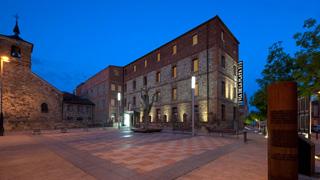
This modern hotel was built in 2011, over the stones of the convent of San Francisco.
The hotels design gave priority to the space in the rooms, the furniture and the welcoming contemporary decoration. If offers the rest you deserve while enjoying the best location in the historic district.
Palacio de Canedo
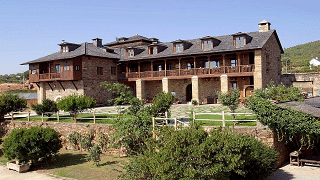
A place to rest and disconnect with rustic decoration.
This 14-room guesthouse is a breath of fresh air just off the Camino. The onsite winery and canning facilities are well worth the visit. Each rooms is uniquely decorated and themed making for a cozy stay amongst pilgrims and travelers alike.
Parador de Monforte de Lemos
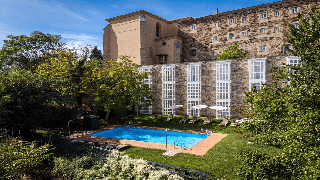
The historic site of San Vicente do Pino is located in the uppermost part of the town of Monforte de Lemos.
San Vicente do Pino Monastery and the palace of the counts of Lemos houses the Parador de Monforte. The monastery dates back to the 9th century, although the current structure was built in the 17th century in the neoclassical style.
Parador de Santiago – Hostal Reis Catolicos
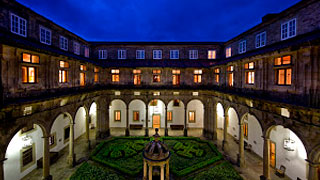
The Parador de Santiago is a blend of history, art and tradition. It is the emblem of the city and the prefect nights rest for pilgrims
The hotel is located in Obradoiro Square near the cathedral, creating an area of spectacular beauty in one of the most visited provincial capitals of the world. A stay at this Parador means a visit to a truly unique and exclusive location.


